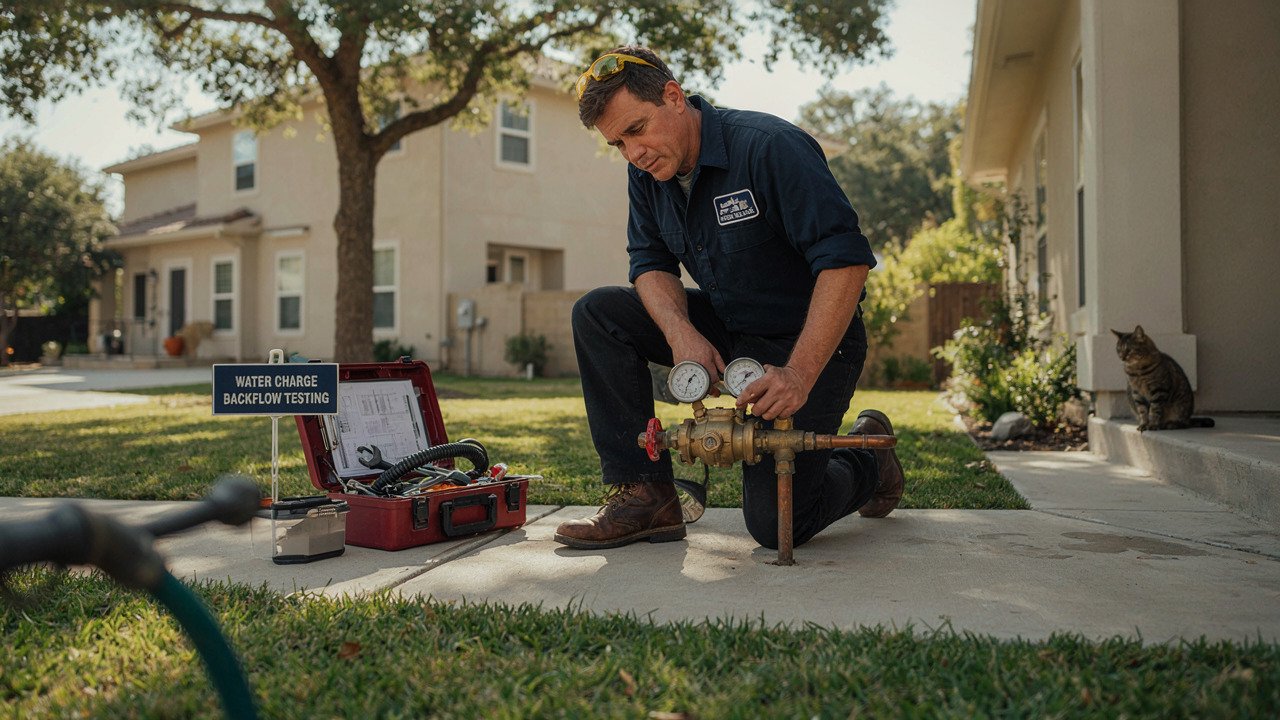
Got a letter from Sydney Water about backflow testing and wondering if you have to pay Sydney Water to do the test? You are not alone. Every year thousands of Sydney property owners, tenants and managers get that notice and the first question is about cost.
This guide gives you a straight answer. We explain what Sydney Water actually charges, what a private accredited tester charges, who has to arrange the test, who pays under a lease, what happens if you ignore the notice and how to avoid paying more than you need to. All figures are from the current Sydney Water pricing schedules for 2025 to 26 and 2026 to 27.
Does Sydney Water Charge for Backflow Testing?
Yes, but not in the way most people think.
Sydney Water does not charge you for a routine annual test that you arrange yourself with an accredited plumber. If you book your own tester and lodge the report on time, you only pay your plumber.
Sydney Water does charge in two other situations.
First, there is a quarterly administration fee for every property that has a testable backflow device. This covers running the containment programme and tracking compliance. It appears on your normal Sydney Water bill.
Second, if you miss the deadline, Sydney Water can arrange the test for you and bill you for it. That fee is much higher than a private quote and applies per device.
There is no separate Sydney Water report lodgement fee for private tests. If a plumber adds a lodgement fee, that is their own charge, not Sydney Water’s.
Sydney Water Backflow Fees Explained
Here are the official charges that come from Sydney Water, not your plumber. Prices include GST and are from Sydney Water’s residential and business pricing pages.
Backflow prevention device administration fee
This is a fixed quarterly fee, one per property, if you have a testable device. It helps Sydney Water recover the cost of running the backflow prevention containment programme to safeguard the network. From 2025 to 26, the maximum is $10.86 a quarter. From 2026 to 27, the maximum is $11.05 a quarter. In our experience guide we note the same figure for 2026 to 27.
Backflow annual test fee, when Sydney Water arranges it
If you fail to complete annual testing, Sydney Water may arrange for an accredited plumber to attend and complete the testing. The annual test fee will apply for each device tested. The published charge is $531.34 in 2025 to 26 and $553.12 in 2026 to 27. Our own cost guide references the 2026 to 27 figure of $553.12 when Sydney Water sends its own plumber.
Backflow annual test: no access fee
If Sydney Water arranges a test and the plumber cannot get access to the device for a qualifying reason, a no-access fee applies. The published charge is $414.68 in 2025 to 26 and $431.68 in 2026 to 27. This is also noted in our guide as the additional penalty when entry cannot be gained.
These are not fines. They are cost recovery charges for non-compliance visits. The administration fee is recurring. The annual test fee and no access fee only happen if you do not arrange testing yourself.
| Charge Type | Who Bills It | When It Applies | Current Amount 2025 to 26 | Current Amount 2026 to 27 |
| Backflow administration fee | Sydney Water | Quarterly, per property with testable device | $10.86 per quarter | $11.05 per quarter |
| Annual test fee arranged by Sydney Water | Sydney Water | Only if you miss deadline and they send a plumber | $531.34 per device | $553.12 per device |
| No access fee | Sydney Water | If their plumber attends but cannot access device | $414.68 | $431.68 |
| Private testing and report lodgement | Your chosen accredited tester | When you book privately and on time | Market rate, our flat rate $199 plus GST | Same |
How Much Does Backflow Testing Cost in Sydney?
If you book privately, you pay your plumber, not Sydney Water, for the physical test.
At Backflow Testing Sydney, our advertised price is $199 plus GST per valve, which is $218.90 including GST. That is listed on our homepage as Sydney Water Accredited testing at a flat $199 plus GST rate with results lodged within 24 hours and again as $199 per valve plus GST. The price covers on-site testing by a licensed plumber, a Sydney Water-compliant test report, lodgement with Sydney Water within 24 hours and a confirmation certificate emailed to you.
A good private quote should clearly include:
- Site visit and time on site
- Testing of all testable valves with a calibrated gauge
- Minor cleaning of seals if needed to get a pass where possible
- Preparation of the inspection and maintenance report
- Lodgement to Sydney Water and proof for your records
- No call-out fee and no hidden travel fee
In Sydney, market quotes for private testing usually sit between $150 and $300 per device, depending on location and number of devices. We publish a detailed breakdown of what cheap quotes often leave out in our guide, Are You Getting Ripped Off? The Truth About Sydney Backflow Testing Costs. If you want to see how a low advertised price can turn into $274 or more after call-out and lodgement add-ons, read that guide on “Are You Getting Ripped Off? The Truth About Sydney Backflow Testing Costs”.
That guide also explains the $553.12 and $431.68 figures that apply when Sydney Water has to step in, so you can compare official utility charges against private market pricing.
For multiple devices at one address, like a domestic line plus fire service plus irrigation, ask for multi-device pricing. We test all devices on site in one visit and can price accordingly, which is noted in our pricing section.
Does Sydney Water Carry Out the Physical Testing?
Sydney Water does not do your routine annual test for you. Their role is administration and compliance.
Sydney Water maintains the register of properties with testable backflow prevention devices, sends annual notices, monitors whether reports are lodged on time and applies the quarterly administration fee and any non-compliance charges.
The physical test must be done by a plumber who holds backflow containment accreditation and a current plumbing licence. At Backflow Testing Sydney, our licence is 275183C, and we are Sydney Water accredited.
The accredited tester must:
- Identify the device type and hazard rating
- Isolate water for a short period and connect a differential pressure gauge
- Carry out the pressure tests required by AS/NZS 2845 and AS/NZS 3500.1
- Record pass or fail results and device serial numbers
- Lodge the report through the Sydney Water portal within two working days. We lodge within 24 hours as stated on our homepage
Only when you fail to arrange testing does Sydney Water engage its own contractor to visit, test and lodge. That is when the $531.34 to $553.12 annual test fee is billed to you.
Who Pays for Backflow Testing, the Landlord or Tenant?
Under Sydney Water requirements, the property owner is responsible. The device is part of the property water service. The owner must ensure it is installed, maintained and tested annually. This is consistent with Sydney Water guidance that the property owner is responsible for keeping devices working and tested on time.
That regulatory responsibility is separate from who actually pays under a lease.
For residential tenancies in NSW, council rates and fixed water service charges are generally owner costs, while water usage may be passed on if the property meets efficiency requirements. Backflow testing is not water usage. It is a compliance and maintenance cost for the property infrastructure. Most residential leases will therefore leave it with the owner, but you must check your specific agreement.
For commercial, retail and industrial leases, it depends on what the lease says about outgoings, maintenance, statutory compliance and essential safety measures. Some leases make the tenant responsible for all statutory compliance costs for their fit-out. Others keep base building services with the landlord. A cafe in Surry Hills, a warehouse in Blacktown and a medical centre in Parramatta can have three different outcomes on the same Sydney Water notice.
Practical approach for managers:
- Strata managers and building managers usually recover costs through strata levies or building outgoings
- Property managers should check the lease schedule for compliance obligations before charging.
- Business operators who have received a notice should forward it to the owner or managing agent promptly and confirm in writing who will book
If you are unsure, get advice from your property manager or legal adviser. Do not assume the tenant automatically pays just because they received the notice at the premises.
Is Backflow Testing Tax Deductible for Rental Property Owners?
Deductibility depends on circumstances. The Australian Taxation Office treats general repairs and maintenance on a rental property that is genuinely available for rent as immediately deductible, while capital improvements are deductible over time as capital works.
Backflow testing is usually considered a recurring compliance and maintenance expense to keep the property in a rentable, compliant condition. If the property is income-producing at the time the expense is incurred, many owners can claim the testing fee as a repair and maintenance expense in the year it is paid. That aligns with ATO guidance that repairs to a rental property will generally be deductible if the property remains available for rental.
There are limits:
- Initial repairs for defects that existed when you bought the property are generally not immediately deductible
- If you install a new backflow device where there was none, that may be a capital improvement or plant and equipment, not a repair, and may need to be depreciated
- If the property is not genuinely available for rent, you may not be able to claim
The ATO also says you can claim an immediate deduction for general repairs like replacing a broken window, but if you rip out an old bathroom and put in a new and improved one, this is a capital improvement. Use that same distinction for backflow. Testing is maintenance. Full replacement with an upgrade may be capital.
Keep invoices, test reports and lodgement confirmations. For specific advice on your rental, speak to your accountant or tax agent. This information is general only and not tax advice.
For authoritative detail, see the ATO pages on repairs and maintenance and getting your rental right.
What Happens If You Ignore a Sydney Water Backflow Notice?
A Sydney Water backflow notice is part of the annual compliance cycle. All properties with a medium or high hazard rating must have the containment device tested annually.
If you ignore it:
- Reminder letters are issued and the quarterly administration fee continues on your bill
- Sydney Water may arrange its own accredited plumber to attend. You will then be billed the official annual test fee of $531.34 in 2025 to 26 or $553.12 in 2026 to 27
- If the contractor cannot access the device, you may also be billed the no-access fee of $414.68 or $431.68
- Ongoing noncompliance can lead to further formal notices and, in serious cases, action to protect the water network
Ignoring the notice does not remove the requirement. It just moves you from a private market price to a regulated utility price that is more than double.
How to Avoid Unnecessary Backflow Testing Costs
You cannot avoid the quarterly administration fee if you have a testable device. You can avoid the extra annual test and no access fees.
- Book before the due date on your notice. Put the Sydney Water property number in your calendar reminder
- Ask what the quote includes. Specifically ask if they call out, travel and Sydney Water lodgement is included
- Confirm report submission. Ask if lodgement is within 24 hours and if you get written confirmation
- Ensure clear access. Keep the area around the valve clear of storage, plants and building materials. If your plumber spends an hour looking for the valve, you may pay extra or risk the Sydney Water no-access fee noted earlier
- Group devices. If you have more than one device at one property, have them tested in one visit to save travel
- Use a specialist. An accredited tester who does backflow daily will have a calibrated gauge and the Sydney Water portal access ready, which keeps costs predictable
Book Backflow Testing in Sydney
We are Backflow Testing Sydney. We provide Sydney Water-accredited testing at a flat $199 plus GST per valve, with no call-out fee and 24-hour lodgement. Our licence is 275183C, and we have completed more than 500 tests across restaurants, commercial buildings, strata, healthcare and industrial sites.
We service Greater Sydney, including Sydney CBD, Parramatta, Chatswood, North Sydney, Surry Hills, Newtown, Redfern, Alexandria, Mascot, Botany, Ultimo, Pyrmont, Bondi, Randwick, Cronulla, Bankstown, Liverpool, Penrith, Blacktown, Castle Hill, Ryde, Strathfield, Manly, Hornsby, Epping and Macquarie Park.
If you have a Sydney Water notice, annual compliance due or you are not sure what device you have, you can book and pay online in under two minutes, and we will handle testing and lodgement end to end.
Book today and keep your property compliant without the surprise fees.
Frequently Asked Questions
Does Sydney Water charge for testing?
Sydney Water charges a quarterly administration fee for properties with testable devices and charges an annual test fee only if you miss your deadline and they arrange the test for you. Private annual tests are paid to your plumber.
Does Sydney Water perform the physical backflow test?
No, not for routine compliance. You must use an accredited backflow plumber to test and lodge the report. Sydney Water only sends its own contractor if you fail to complete testing on time.
Who pays for backflow testing, the landlord or tenant?
The property owner is responsible under Sydney Water rules. Whether the cost can be passed on depends on your lease. Residential leases usually keep it with the owner. Commercial leases vary, so check your outgoing clauses.
Is there a separate Sydney Water report submission fee?
No. Sydney Water does not charge a separate lodgement fee for private tests. The quarterly administration fee covers programme running costs. Any lodgement fee in a plumber quote is their own charge, not Sydney Water.
Is backflow testing tax deductible for rental property owners?
It can be if the property is income-producing and the expense is for ongoing maintenance and compliance. Testing is often immediately deductible, while new installation may be capital. Get personal tax advice and keep all records.